
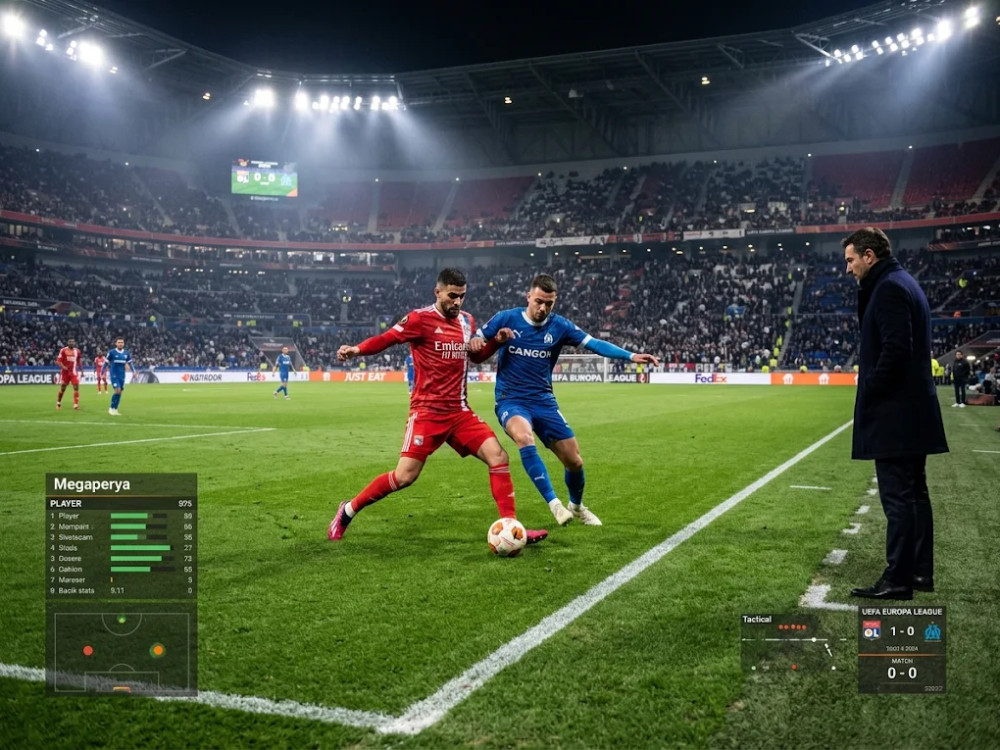
The early results offer plenty to discuss. Lyon delivered an entertaining victory over Crystal Palace before suffering a heavy defeat against Hoffenheim. Marseille struggled to find attacking momentum against Olympiacos and Sturm Graz, while Rennes produced one of the more encouraging performances by a French side with a 2–2 draw away to Juventus.
For football enthusiasts, these contrasting results tell a familiar story: French clubs have the technical quality to trouble established European opponents, but consistency remains the real test.

Photo by (Augustin-Foto) Jonas Augustin on Unsplash
Lyon: Attacking Quality Needs Defensive Stability
Lyon's 3–2 victory over Crystal Palace on October 15 showed the club's ability to turn a competitive match into an attacking spectacle. However, its subsequent 3–0 loss to Hoffenheim on October 22 exposed a different side of the team.
The contrast matters. A club with European ambitions cannot rely solely on individual brilliance or an aggressive attacking approach. Against well-organized opposition, defensive discipline, midfield control, and decision-making under pressure become just as important as creativity in the final third.
In my view, Lyon's immediate challenge is not a lack of attacking potential but the ability to reproduce its best football from one match to the next. The Europa League rewards teams that can adapt, not just those capable of producing an exciting night.
Marseille: Reputation Is Not Enough
Marseille's opening European campaign has been less convincing. After losing 1–0 to Olympiacos on October 15, the French side suffered another narrow defeat, falling 1–0 to Sturm Graz on October 22.
These results should concern supporters because they highlight the cost of failing to convert competitive performances into goals. In a league-phase format where every point affects a club's position, missed opportunities can become expensive quickly.
Marseille possesses the history and fan culture expected of a major French club. Yet reputation offers little protection when opponents defend compactly and punish mistakes. The team needs sharper attacking execution and greater composure in decisive moments.
The encouraging part is that narrow defeats do not automatically signal a disastrous campaign. The concern is whether Marseille can correct its problems before the remaining fixtures make recovery significantly harder.
Rennes: A Draw That Carries Real Weight
Rennes arguably supplied one of the more compelling French performances of the third matchday, drawing 2–2 away to Juventus on October 22.
The result was particularly notable because Juventus had begun its campaign strongly. Rennes showed enough resilience to leave Turin with a point, preventing the Italian side from maintaining its perfect record.
That performance offers a useful reminder: European football is not decided by club reputation or domestic league standing alone. Tactical flexibility, effective transitions, and composure under pressure can narrow the gap between teams with different resources and expectations.
Rennes still has work to do, but its draw demonstrated the value of remaining competitive away from home. In a long league phase, such results can prove important when qualification places are decided.
What the Results Mean for Ligue 1
The broader issue is what these European performances say about French football. Ligue 1 has developed technically gifted players and competitive teams, yet translating domestic potential into consistent continental success remains a challenge.
European competition demands more than talented individuals. Clubs must manage squad depth, tactical adjustments, injuries, and the pressure of playing different opponents every few weeks. A strong domestic performance does not guarantee the same level of control against unfamiliar European sides.
The Europa League also offers French clubs a valuable opportunity to strengthen their international reputations. Unlike the Champions League, where the financial and competitive demands can be overwhelming, the second-tier competition provides a realistic route to a major European trophy, provided teams approach it with sufficient ambition.
There is also a lesson for supporters who follow match predictions and football discussions. The temptation to treat every fixture like a megaperya-style game of chance misses what makes football compelling: results involve uncertainty, but tactical decisions, player performance, and preparation give analysts meaningful evidence to examine. No single result tells the whole story.
The Road Ahead: Consistency Will Decide Everything
With the league phase scheduled to conclude on January 28, 2027, the French representatives still have time to reshape their campaigns. The upcoming fixtures will reveal whether Lyon can stabilize its defense, Marseille can rediscover its attacking edge, and Rennes can build on its promising result in Turin.
The league-phase format makes every match significant. Teams must accumulate points across eight fixtures, leaving less room for prolonged slumps than a traditional knockout tie might suggest. Strong finishes will matter, but avoiding preventable setbacks is equally important.
For French football, the stakes extend beyond individual clubs. Strong Europa League campaigns can improve Ligue 1's standing in European football and reinforce the perception that French sides deserve greater respect outside their domestic competition.
The verdict is still open. Rennes has offered encouraging evidence of resilience, Lyon has demonstrated both attacking promise and defensive vulnerability, and Marseille must respond to a difficult start. Their paths are different, but the objective is shared: turn potential into results.
For neutral fans, that uncertainty is part of the appeal. For French supporters, it is also a reminder that European credibility must be earned over 90 minutes at a time.