
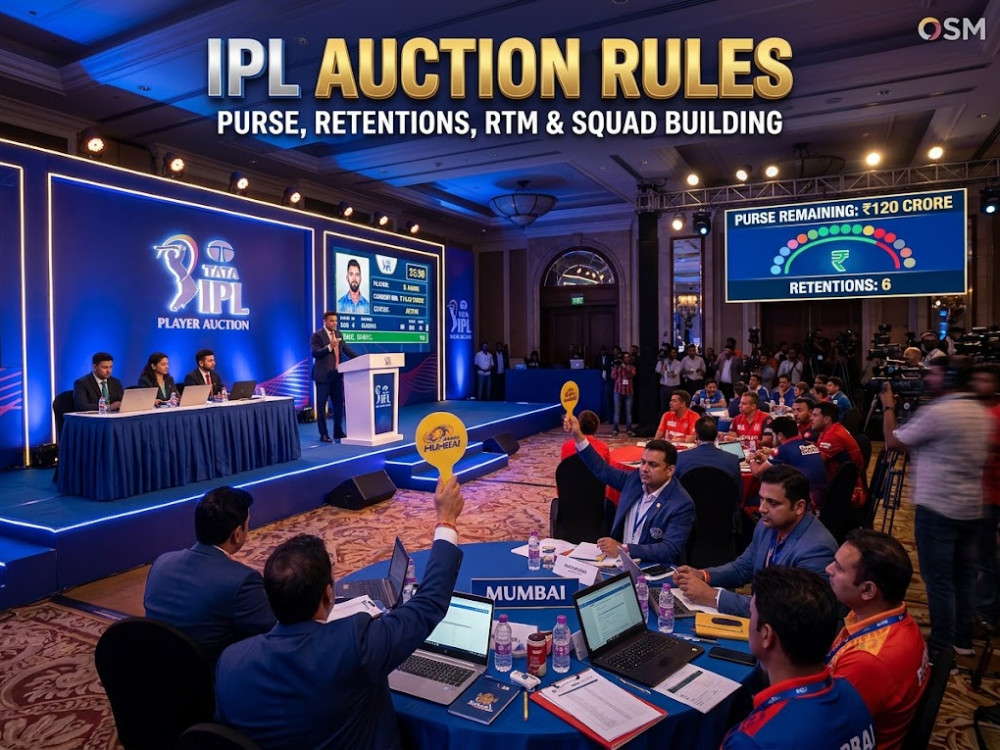
IPL auction rules determine how franchises protect players from an existing group, spend their budget at auction and shape a balanced squad for the season ahead. For the 2025-27 cycle, the IPL Governing Council allowed franchises to retain or secure a total of six players through retentions and the Right to Match (RTM) route, while setting a ₹120 crore auction purse for IPL 2025. The rules therefore make auction planning as important as identifying individual talent.
The auction purse and overall salary cap
Every franchise entered the IPL 2025 player-building process with an auction purse of ₹120 crore, according to the IPL Governing Council’s September 2024 regulations. This is the sum available for retention costs and auction purchases, so retaining a player affects the money left to bid for others. A franchise cannot treat retentions as separate from its auction planning; both decisions sit within the same financial framework.
The ₹120 crore purse is not identical to the total salary cap. The IPL stated that the salary cap includes the auction purse, incremental performance pay and match fees. The total salary cap was set at ₹146 crore for 2025, ₹151 crore for 2026 and ₹157 crore for 2027. This distinction matters because an auction purchase price is only one part of the wider cost structure associated with assembling and maintaining a playing group.
The IPL also introduced a match fee for the first time for the 2025-27 period. Each playing member, including the Impact Player, receives ₹7.5 lakh per match in addition to the player’s contracted amount. This makes the auction price a useful indicator of a franchise’s commitment, but not a complete measure of what a player could earn across the season.
Retentions: the six-player limit
The central retention rule for the 2025-27 regulations is straightforward: a franchise can keep a total of six players from its existing squad through a combination of direct retentions and RTM options. The number is a combined ceiling, rather than six retentions plus additional RTMs. A team must therefore decide how many players it wants to protect before the auction and how many choices it wishes to preserve for the auction itself.
The six-player allowance is subject to two composition limits. Of the six retained or RTM players, no more than five can be capped players, counting Indian and overseas cricketers together. A maximum of two can be uncapped players. These limits prevent a side from protecting every type of player in unlimited numbers and force franchises to choose between experience, domestic potential and overseas depth.
A retention is a clear pre-auction commitment. It gives a franchise certainty about a player’s place in its group, but it also reduces flexibility. The team must judge whether the player’s value, role and availability are strong enough to justify using one of its limited protected slots before knowing how the auction market will develop.
Capped and uncapped Indian players
The regulations included a specific definition under which a capped Indian player could become uncapped. For this classification, the player must not have appeared in the starting XI in international cricket—Tests, ODIs or Twenty20 Internationals—in the five calendar years before the relevant IPL season. The player also must not have a BCCI central contract.
This provision applies to Indian players only. It is relevant because the capped and uncapped limits apply across the total of six retention and RTM slots. Classification can influence a franchise’s choices, particularly when it wants to retain experienced domestic performers without exhausting too many of the permitted capped-player positions.
How the Right to Match fits in
The Right to Match is not an extra benefit beyond the six-player limit. It is one of the two routes through which a franchise can keep a player from its existing squad. The IPL Governing Council left the exact mix to each franchise: it can use a combination of direct retentions and RTM options that suits its own planning.
In practical terms, the key difference is timing. A direct retention is decided before bidding begins, while an RTM option is retained for the auction process. That can give a franchise more information about market interest in a player before it commits one of its available protections. However, using RTM slots also means accepting uncertainty, since auction demand can be difficult to predict.
The official regulations establish the total RTM-and-retention limit and the player-category restrictions, rather than presenting RTM as a separate pool of players. This is why the phrase “RTM card” can be misleading if it suggests an unlimited auction advantage. It is better understood as a controlled mechanism within the same six-player framework.
For supporters following team construction and player roles, tools built around dream11 prediction can also underline why a well-balanced squad matters beyond headline purchases: opening options, bowling depth and all-round skills can affect selection across a season.
Squad building is more than buying famous names
An IPL auction is an ascending-bid process in which franchises compete for players from the available pool. Players register through their respective national cricket boards, select from BCCI-provided base-price options, and are then shortlisted for the auction pool, according to Britannica. The process combines scouting, role definition and budget control, rather than simply ranking players by reputation.
A side that spends heavily on a few names may have less room to address remaining requirements. Conversely, an overly cautious team can miss specialists it needs for particular match situations. Retention decisions intensify this balance: each protected player gives certainty in one role while reducing the amount of purse and flexibility available elsewhere.
The IPL auction is also periodically conducted as a mega auction, usually once every three years, when teams release more players than in a regular or mini auction, according to Britannica. That format creates a greater need for long-term planning because franchises have more vacancies to fill and fewer established combinations to carry forward.
Domestic and overseas balance
Both Indian and overseas players can register for the IPL auction. The 2025-27 regulations also placed a distinct condition on overseas participation: an overseas player must register for the Big Auction. If that player does not register, the player is ineligible to register for the following year’s player auction.
This rule has implications for franchise planning. Overseas players can bring specialist skills, but teams must account for player availability, competition for places and the value of Indian options in the same role. The retention regulations count capped Indian and overseas players together within the maximum of five capped players, so a franchise cannot consider overseas retention decisions in isolation.
Squad size is often discussed as though it is only a numerical target. In reality, the more important question is whether the group covers the demands of a full tournament: top-order batting, middle-order flexibility, wicketkeeping, pace, spin and fielding options. The regulations announced for 2025-27 focus chiefly on player protection, purse structure and eligibility, while each franchise’s final balance depends on its auction choices.
Availability rules and auction commitments
The regulations also attach consequences to players who register and are bought but then withdraw before the season begins. Any player who becomes unavailable after being picked at auction faces a ban from the tournament and the player auction for two seasons. The rule gives franchises greater protection after they have committed purse money and planned roles around a signing.
For overseas players, registration decisions also carry consequences beyond a single auction. Missing the Big Auction makes the player ineligible for the next year’s auction. Together, these provisions encourage clarity before bidding begins and reduce the risk that a franchise loses a planned squad member after the auction has finished.
Conclusion
IPL auction rules for 2025-27 are built around controlled flexibility. The ₹120 crore IPL 2025 purse, six-player retention-and-RTM ceiling, capped-player limits and availability rules require franchises to weigh certainty against opportunity. Successful squad building is not simply about winning bids; it is about using limited protections and funds to create a group that can cover roles throughout the season.