
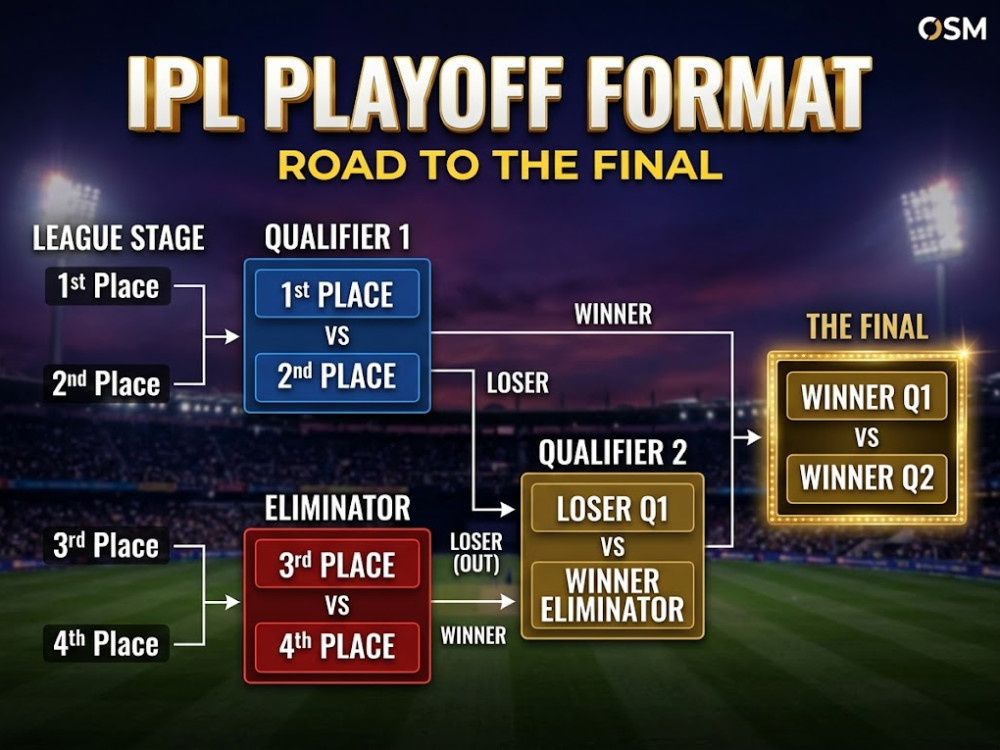
The IPL playoff format rewards league-stage consistency while keeping the knockout phase decisive. The top four teams on the points table qualify, but finishing first or second provides a major advantage: those sides receive two possible routes to the final. Teams placed third and fourth, by contrast, must win every remaining match to become champions.
The four-match route to the IPL trophy
The IPL uses a four-match playoff structure rather than two conventional semi-finals. It is based on the Page playoff system, which combines elements of single elimination and a second chance for the highest-ranked teams. The format has been used in the IPL since 2011 and is designed to ensure that performances across the league stage carry meaningful value.
The four playoff fixtures are Qualifier 1, the Eliminator, Qualifier 2 and the Final. Their order matters because each result determines the participants in the next match. Only one team is eliminated after the first playoff game involving the third- and fourth-placed sides, while the loser of Qualifier 1 remains in the competition.
| Playoff match | League-stage positions involved | Result |
|---|---|---|
| Qualifier 1 | 1st vs 2nd | Winner reaches the Final; loser goes to Qualifier 2 |
| Eliminator | 3rd vs 4th | Winner goes to Qualifier 2; loser is eliminated |
| Qualifier 2 | Loser of Qualifier 1 vs winner of Eliminator | Winner reaches the Final |
| Final | Winner of Qualifier 1 vs winner of Qualifier 2 | Winner becomes IPL champion |
How teams reach the playoffs
At the end of the league phase, the four highest-placed teams in the IPL points table advance to the playoffs. Teams are ranked by points, with net run rate used when teams are level on points. That makes every league match significant, including games involving teams that may already be in contention for the top four.
The points table does more than decide qualification. It determines the playoff path. There is a sharp practical distinction between ending the league stage in second place and third place. Both positions secure playoff participation, but second place carries a safety net, while third place leads directly into an elimination contest.
This is why close attention is paid to net run rate during the latter part of a league season. It can affect whether a team reaches the playoffs at all, but it can also decide whether that team earns the more favourable top-two route. A side may have the same number of points as a rival yet face a very different knockout challenge because of its final table position.
Qualifier 1: the top-two advantage
Qualifier 1 is contested by the teams that finish first and second in the league standings. The winner qualifies directly for the IPL Final. This is the quickest route to the title match, requiring only one playoff victory after the league phase.
The losing team is not eliminated. Instead, it moves into Qualifier 2, where it faces the winner of the Eliminator. That second opportunity is the defining benefit of a top-two finish. A team can lose its first playoff match and still recover to reach the Final.
The 2026 edition offered a recent illustration of the direct reward attached to Qualifier 1. Royal Challengers Bengaluru defeated Gujarat Titans by 92 runs in Qualifier 1 of the Indian Premier League at Dharamsala on 26 May 2026, according to ESPNcricinfo. Bengaluru progressed straight to the Final, while Gujarat retained a route through the next qualifier.
A top-two finish does not guarantee the trophy, of course. The Qualifier 1 winner must still win the Final. But it does reduce the number of knockout matches required and removes the immediate pressure of a must-win first playoff game. It also gives the winning side time between matches while the other finalist is decided.
The Eliminator: no margin for error
The Eliminator is played between the teams that finished third and fourth in the league stage. Its purpose is exactly what the name suggests: the losing side is eliminated from the tournament immediately. The winner stays alive and progresses to Qualifier 2.
For the third- and fourth-placed teams, there is no second chance. A team that has had a strong league campaign but finishes outside the top two must win three consecutive playoff matches to become champion: the Eliminator, Qualifier 2 and the Final. That is one more match than a team starting from first or second.
The Eliminator also creates a distinct tactical situation. Teams cannot approach it as though they have another route available if a plan fails. Selection calls, batting order decisions and bowling resources all carry the urgency of a final, even though the actual Final is still to come.
Match forecasts can add to the discussion around such high-pressure fixtures, though they should never be treated as certainty. Readers looking at material labelled today match prediction 100 sure should weigh it against form, conditions and the unpredictable nature of a single T20 match.
Qualifier 2: the final place is decided
Qualifier 2 brings together two teams arriving by different paths: the losing side from Qualifier 1 and the winning side from the Eliminator. The winner becomes the second finalist. The loser’s campaign ends.
This match is sometimes difficult to interpret because the two participants have faced different levels of pressure. The Qualifier 1 loser has the advantage of having earned a top-two finish during the league stage, but it enters Qualifier 2 after a defeat. The Eliminator winner arrives with momentum from a knockout victory, but it has already had to survive one do-or-die match.
The IPL 2025 Qualifier 2 showed the role of this fixture in the bracket. Punjab Kings defeated Mumbai Indians by five wickets in Qualifier 2 of the Tata Indian Premier League 2025 at Narendra Modi Stadium, Ahmedabad, on 1 June 2025, according to the IPL match page. Punjab Kings advanced to meet the Qualifier 1 winner in the Final.
Qualifier 2 is therefore not a semi-final in the conventional sense, even though it decides the second finalist. Its participants are defined by earlier playoff outcomes rather than by two fixed league-stage positions. The structure specifically preserves the top-two advantage while still allowing a third- or fourth-placed side to make the Final.
The Final: one match for the championship
The IPL Final is played between the winner of Qualifier 1 and the winner of Qualifier 2. Unlike Qualifier 1, it provides no fallback route. The team that wins the Final becomes IPL champion, while the other finishes as runner-up.
The Final can feature the league stage’s first- and second-placed teams, but the format does not require that outcome. A team finishing third or fourth can reach the title match by winning the Eliminator and Qualifier 2. It can then become champion by defeating the Qualifier 1 winner.
That possibility is important to the appeal of the format. The league table is rewarded, rather than made irrelevant, but the lower-ranked playoff qualifiers are not excluded from the title race. They simply have a more demanding route and must defeat more opponents under knockout pressure.
Why this format differs from straight semi-finals
In a standard four-team knockout bracket, first would play fourth and second would play third, with the two winners meeting in the Final. A defeat in either semi-final would end a team’s campaign. The IPL structure works differently because it gives the two highest-ranked league teams a second opportunity.
This approach recognises that the league stage provides a larger body of evidence than one knockout match. A team finishing first or second has performed better across the league phase than the teams below it, so the playoff format offers a tangible reward for that record.
At the same time, the format keeps the title race open. Teams in third and fourth are not merely making up the numbers. They can still win the IPL, but their task is harder because they must survive from the Eliminator onwards. Every playoff position therefore has a clear consequence.
A simple way to remember the bracket
The easiest way to follow the IPL playoffs is to separate the top two teams from the next two. First plays second in Qualifier 1, with the winner going directly to the Final. Third plays fourth in the Eliminator, with the loser going out. The Qualifier 1 loser then faces the Eliminator winner in Qualifier 2.
In short, the IPL playoff format makes finishing in the top two valuable without making the remaining qualifiers irrelevant. Qualifier 1 awards a direct Final place, the Eliminator creates an immediate knockout, Qualifier 2 selects the second finalist, and the Final decides the champion.